Reviving a RIDGID 9Ah OCTANE Bluetooth Battery
While thinning out my collection of electronics in my future-projects/may-salvage bins, I came across an older RIDGID 18V 9Ah OCTANE Bluetooth battery (R8400809) that had stopped charging normally. The RIDGID charger refused to charge the battery and reported it as defective. Since a 9Ah battery has too many useful lithium-ion cells to throw away without investigating, I opened it up to see what was actually wrong.
This involved working directly with a high-current lithium-ion battery pack and bypassing the normal charging path for diagnosis. A short circuit or charging mistake can cause a fire. This isn’t intended as a step-by-step repair procedure; it’s documentation of what I found on my particular battery.
Checking the cell groups
The pack is a 5S3P battery: five banks in series, each with three cells in parallel. Initially, all five banks were low, around 3.4–3.6 V, measured with a DMM. One bank read noticeably higher than the others, which made me suspect that one of the parallel groups might contain a weak cell.
That by itself wasn’t enough to explain why the charger considered the pack defective, so I connected the balance leads to an iMAX B6 Mini and treated the pack as a 5S lithium-ion battery to further diagnose the banks.
When connecting the balance leads, it’s very important to keep all wires in the correct order. Using multiple colors can help. I also first plugged the leads into a cheap RC hobby LiPo cell checker to be sure the order was correct, to minimize the risk of frying my battery charger.
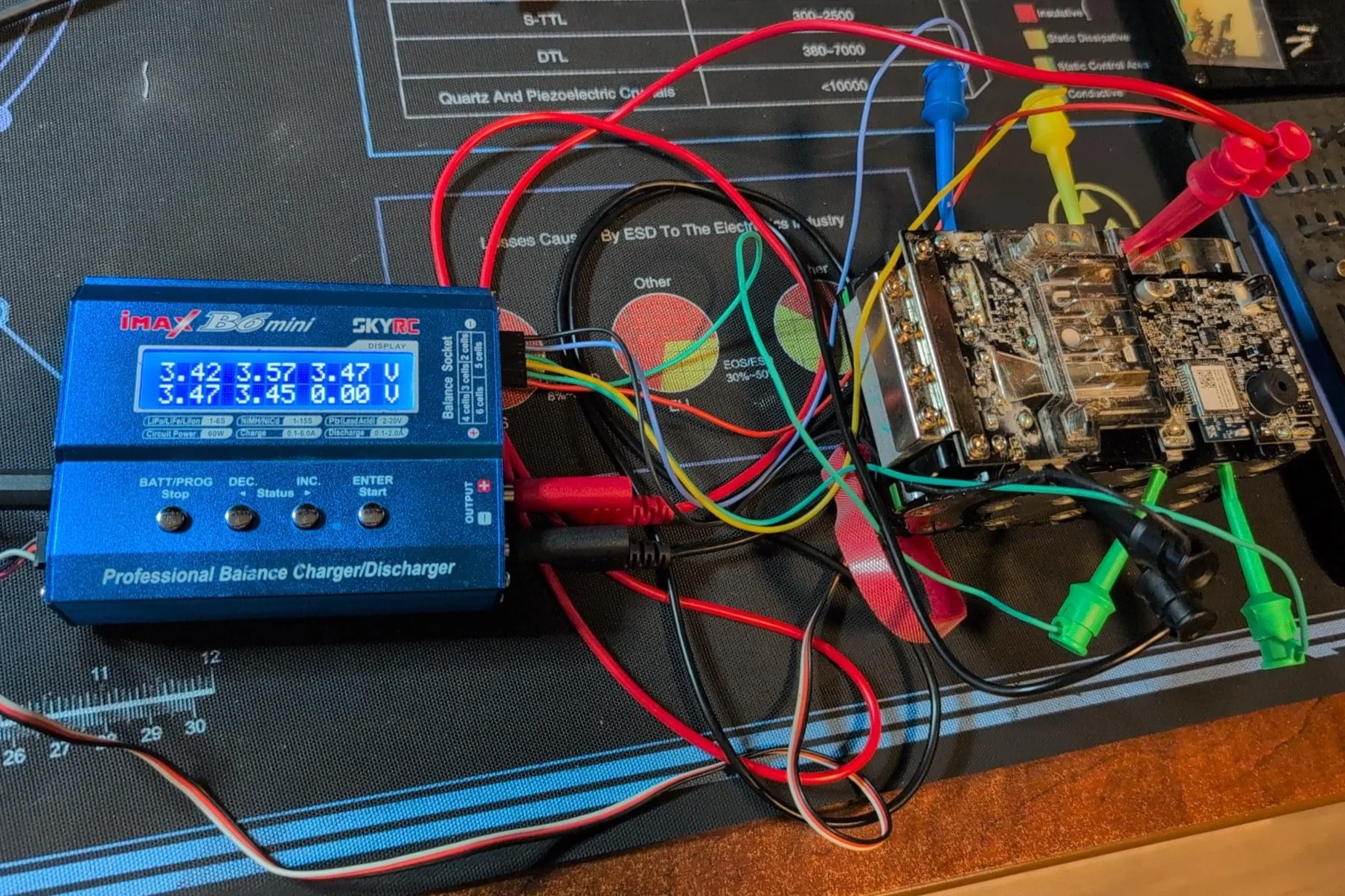
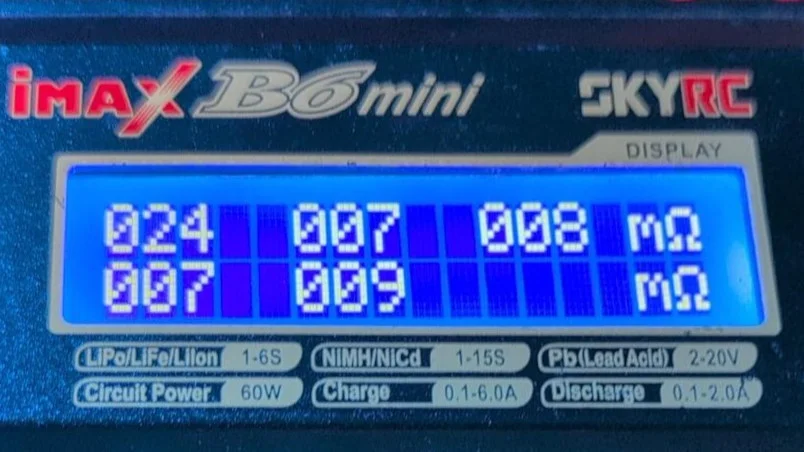
The iMAX B6 confirmed that all banks were on the low end, ranging from 3.42 V to 3.57 V, with bank 2 reading higher than the others. I also checked battery resistance. Banks 2 through 5 reported 7–9 mΩ, but bank 1 read 24 mΩ, roughly three times the others. Some of that may be the wiring rather than the cells: the B6’s measurement includes the clips and leads, and bank 1 shares the main negative connection.
Since the pack wouldn’t charge in its charger, the next step was to charge the banks with the iMAX B6. I selected the LiPo balance charge mode and set the max charge rate to 3A.
The B6 appears to charge the pack first and only balance the banks near the end of the charge cycle, so the balance charge took a long time. I stopped it before the B6 had finished, but the results were promising.
Choosing LiPo mode was an oversight on my part, since these are Li-ion cells. LiPo mode charges to 4.2 V per cell, which is also the standard full-charge voltage for most Li-ion cells, while the B6’s Li-ion mode stops at 4.1 V per cell. Every bank was already above 4.1 V and close to 4.2 V when I stopped, so in Li-ion mode the charge would have completed on its own in about the same time.
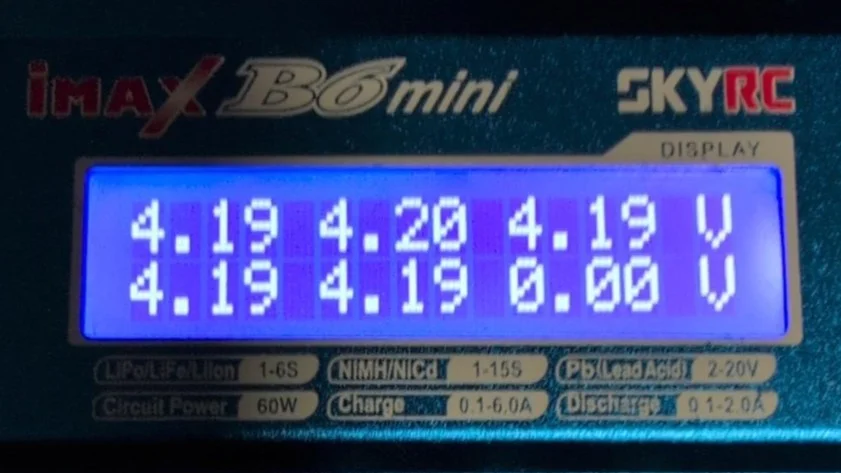
At that point the banks were evenly balanced.
Using the Bluetooth feature
One unusual feature of some of the early OCTANE packs is Bluetooth. In my testing, RIDGID’s current Link app no longer supports these batteries, but I found a copy of the old RIDGID OCTANE Battery Android application (version 1.0.3) and was able to connect to the battery.
After balancing the banks, I connected to the pack with the app, which showed quite a bit of historical information:
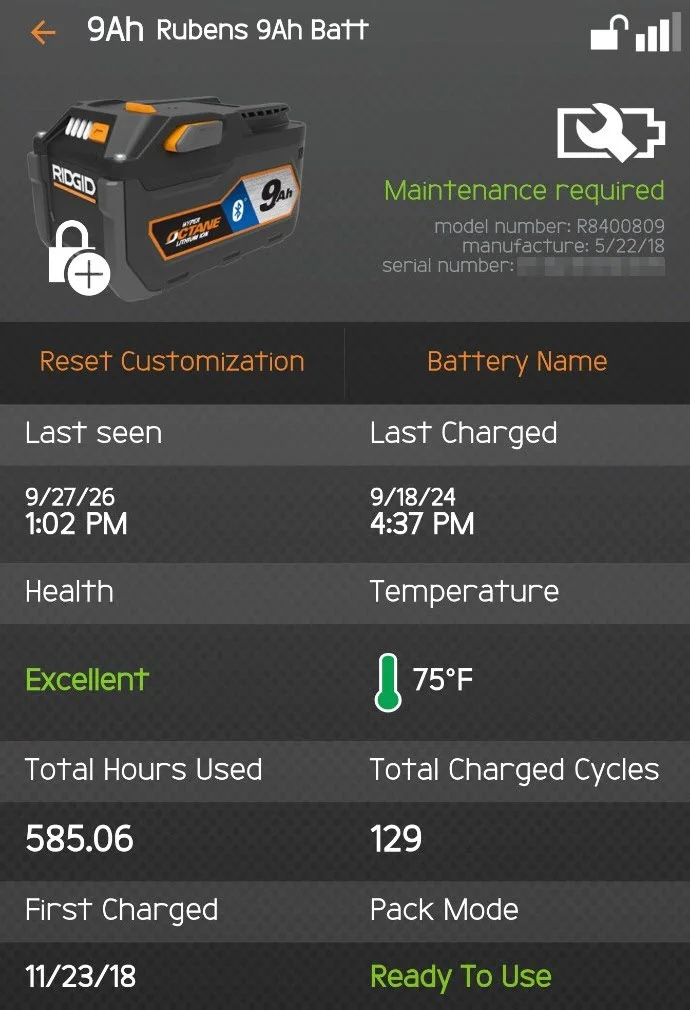
The last-charged date of 9/18/24 matches the roughly two years the battery spent sitting in my bin.
So the battery wasn’t simply dead. Its BMS was alive, Bluetooth was alive, the cells took a charge and balanced evenly, and the BMS itself had decided the pack needed maintenance.
The R8400806/R8400809 operator’s manual doesn’t explain what triggers the maintenance warning, but its storage instructions say to keep the pack at 30–50% charge, below 80°F, and to “charge the pack as normal” every six months of storage. This pack had gone two years without a charge, missing several of those six-month charges.
Discovering a way to reset the BMS
Some online research turned up some interesting tips on Reddit.
Others have reported that the BMS has a programming/debug interface, and when you short pins 3 and 5 it reboots the BMS.
There were two 2×3 test point groups that looked like programming/debug headers, and with a bit of trial and error, I was able to find the one that reset the BMS. The PCB marks pin 1 on each header, which makes the remaining pin numbering straightforward: the odd-numbered pins are all on one side and the even-numbered pins on the other.
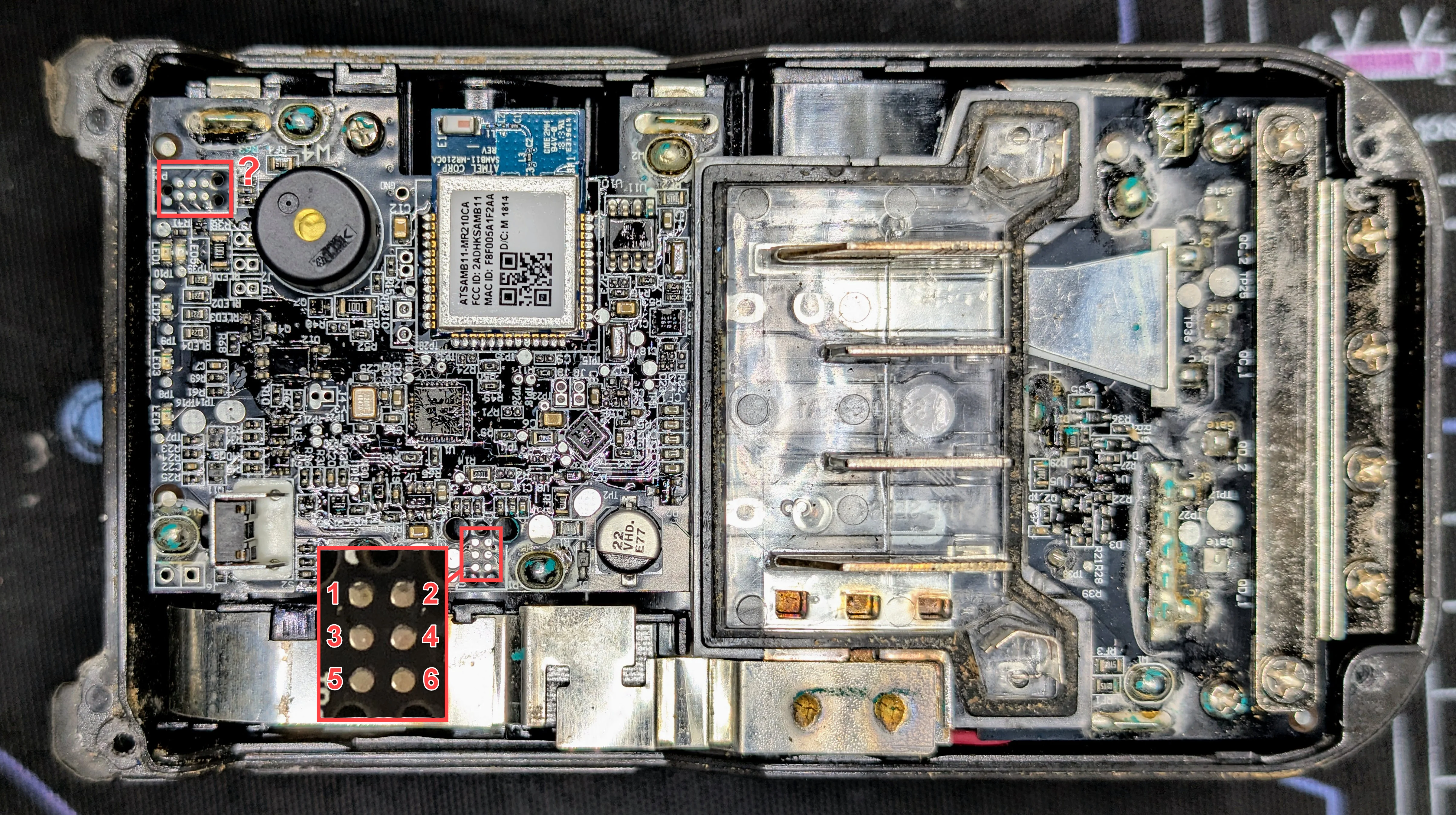
With the iMAX B6 disconnected, briefly shorting pins 3 and 5 with some tweezers caused an unmistakable reset: the battery’s LEDs flashed and the buzzer sounded while the controller rebooted.
That confirmed that the header was doing something useful, but resetting the BMS did not immediately clear the maintenance condition, even after balancing all the banks.
RIDGID chargers
My older RIDGID charger, an R86092, continued to light its red Defective indicator whenever I inserted the battery. This is the same charger that used to charge this pack normally.
I also have a newer, slower-charging RIDGID R86093 charger, which I didn’t have when the pack was shelved. I tried the battery there and it accepted the pack without reporting an error. Since the B6 had already charged the pack, the R86093 simply showed it as full.
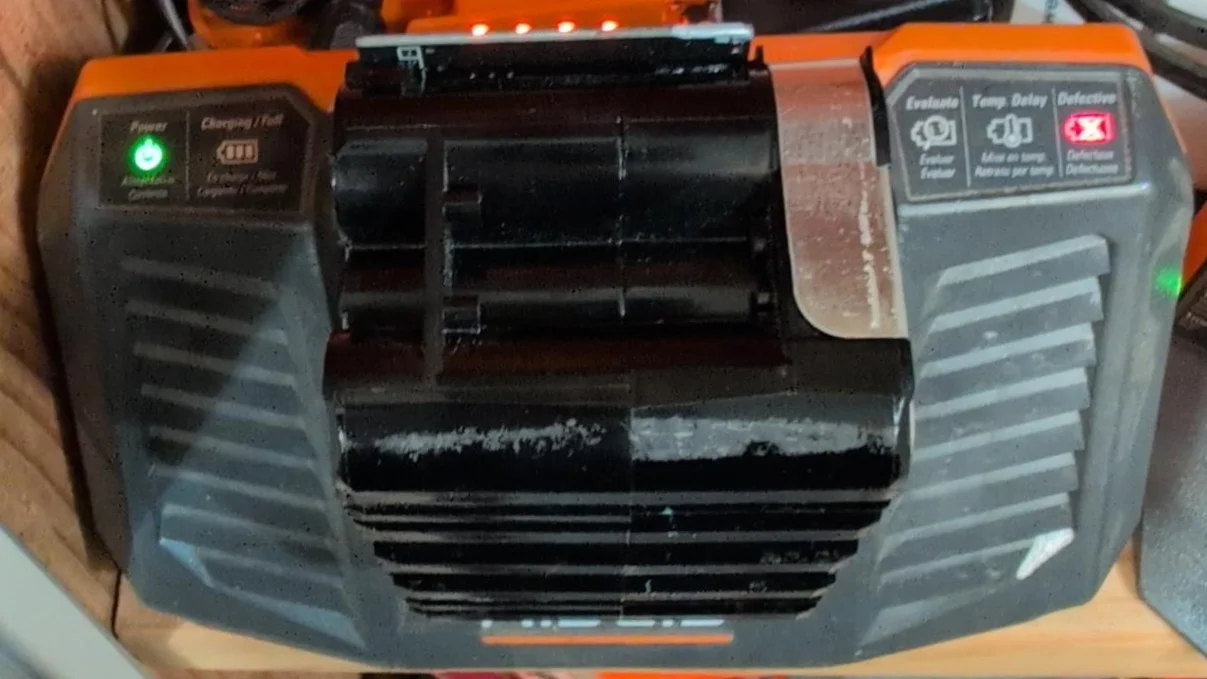
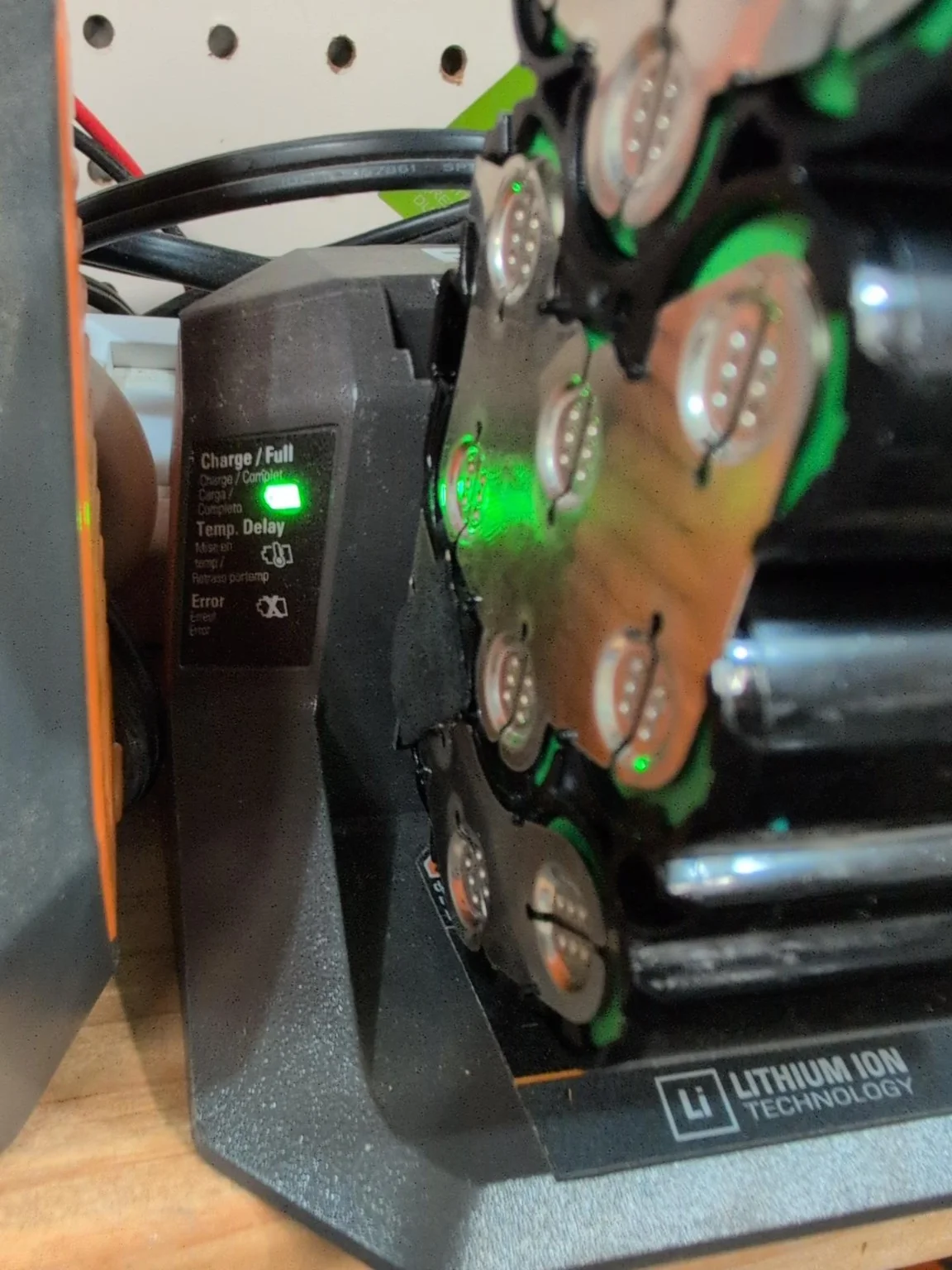
I then tried the battery in several RIDGID tools. It worked normally in all of them, and the battery’s built-in fuel gauge showed a full charge.
After using it in the tools, I put it back on the R86093, which charged it normally. Then I checked the old OCTANE Bluetooth app again.
The maintenance warning was gone!
Oddly, the rest of the status hadn’t changed: health was still Excellent and pack mode was still Ready To Use, just as they had been while the app was also reporting Maintenance required.
I retested on both chargers after reassembling the pack, and letting it run my RIDGID fan for a day. Curiously, the R86092 still reported this same battery as defective. It did accept the battery briefly, then went back to claiming it was defective. I suspect the R86092 has a more sensitive or different algorithm for determining whether a battery is defective, but I don’t know what it’s still detecting.
So what actually fixed it?
I’m not sure exactly what cleared the Maintenance Required state. This is the sequence I followed to revive this RIDGID battery pack:
- Opened the battery pack and connected clips to all the battery banks to create a balance connector.
- Verified the wiring order with an inexpensive LiPo cell checker.
- Connected the pack to a LiPo balance charger. Mine also requires the main positive and negative leads in addition to the balance leads.
- Checked and recorded the bank voltages and battery resistance.
- Balance charged the pack as a 5S LiPo battery. This took a long time, so I stopped it before the charger finished (Li-ion mode would have finished on its own).
- Disconnected the balance charger and reset the BMS by briefly shorting pins 3 and 5 on the programming header.
- Plugged the pack into my RIDGID chargers. The R86092 reported it as defective, but the R86093 accepted it and showed it as full.
- Briefly used the battery in several tools.
- Recharged the battery on the R86093, which charged it normally.
- Connected with the RIDGID OCTANE Battery app and checked the state, which no longer showed Maintenance Required!
What’s next?
My goal going in was to get the pack working again, and if it couldn’t be fixed, to salvage whatever cells were still good. Since it’s working, the next useful test is to use some meaningful portion of its capacity and then measure the five groups again.
If one group falls substantially faster than the others, that would support my original suspicion that one parallel group contains a weak cell. If they remain closely matched under discharge, then the electrochemical side of the pack may be fine and the remaining R86092 behavior is probably elsewhere in the battery/charger logic.
I’m also keeping the old OCTANE APK. Since the original application is obsolete but the Bluetooth interface still works, reverse engineering its BLE protocol could make a useful future project. Being able to read BMS status directly without depending on an abandoned Android application would be particularly useful for diagnosing these older packs.
For now, though, the battery that both the charger and I initially considered a likely teardown candidate is back to powering tools.